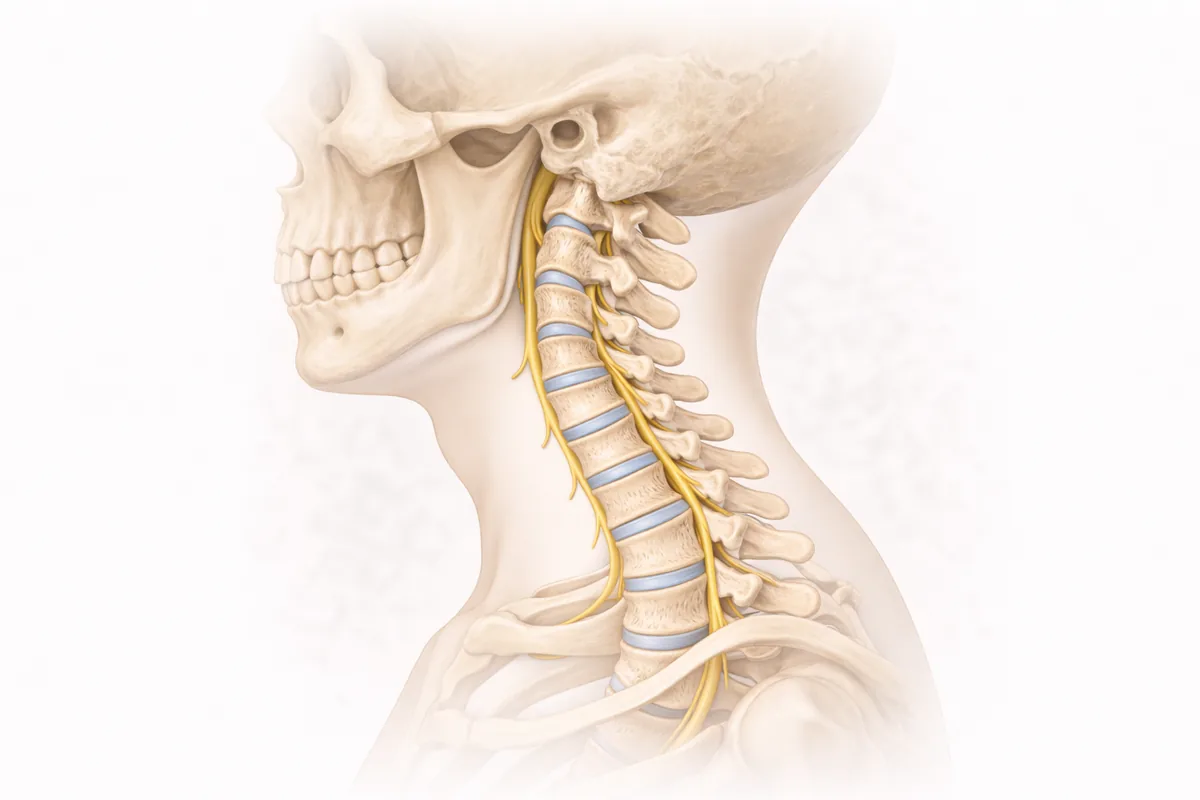
I see patients regularly in my San Antonio and Houston offices who don't realize they've lost the natural curve in their necks. Often, they come in complaining of chronic neck pain, tension headaches, or arm numbness—but the underlying culprit is straightening of the cervical lordosis. It's a pattern I've observed throughout my career as a surgeon, and understanding what happened to your neck curve is the first step toward meaningful recovery.
What Cervical Lordosis Is (And Why It Matters)
Your cervical spine—the seven vertebrae in your neck labeled C1 through C7—naturally curves inward, toward the front of your body. We call this curve lordosis. It's not a flaw or something to fix; it's a remarkable evolutionary adaptation that allows your neck to do something remarkable: support a 10-to-12-pound head all day while absorbing shock and maintaining spinal alignment.
When I review lateral neck X-rays, I'm looking for that inward curve. The normal range is 20 to 40 degrees. Within that range, your vertebrae, discs, and supporting muscles work together efficiently. The load of your head distributes evenly. Your neck muscles don't have to work overtime. Pain stays away.
When the lordosis flattens or reverses, everything changes biomechanically.
How Loss of Cervical Lordosis Develops
In my practice, I've traced lordosis loss back to several patterns:
Text Neck and Screen Posture
Smartphones and computer work have created an epidemic of straightening cervical lordosis in younger patients. When your eyes drift downward to a screen, your entire head drifts forward. Over months and years, this repetitive forward head posture doesn't just change your habit—it restructurally flattens the curve itself.
Disc Degeneration
As intervertebral discs lose height and hydration with age or injury, the space between vertebrae shrinks. Multiple disc herniations or degenerations can reduce the overall cervical curve significantly. This often requires imaging evaluation to understand the extent of change.
Whiplash and Trauma
A motor vehicle accident or significant neck injury can acutely disrupt cervical lordosis. Even after inflammation settles, the curve may not spontaneously restore, leaving patients with chronic instability or pain.
Muscle Imbalance and Weakness
Modern sedentary life weakens the deep cervical flexors—small muscles that support lordosis—while tightening the muscles in the back of the neck. This muscular imbalance pulls the curve toward flattening.
Spondylosis and Arthritis
Cervical spondylosis (osteoarthritis with bone spurs) changes the way vertebrae sit relative to one another, often flattening the curve further.
The Biomechanical Cost
One of the most important conversations I have with patients is about load. Your head doesn't weigh 10 or 12 pounds just when you're standing straight. The mechanical load your neck experiences depends critically on head position:
- In neutral alignment: approximately 10–12 pounds of load on your cervical spine
- Two inches forward: roughly 32 pounds
- Three inches forward: roughly 42 pounds
- Four inches forward: roughly 60 pounds
This exponential increase explains why patients with straightened cervical lordosis develop symptoms so quickly. A seemingly small postural change creates enormous additional stress on discs, joints, and nerves. Over weeks and months, that stress accumulates into pain, stiffness, and progressive degeneration.
Recognizing Loss of Cervical Lordosis
When patients come to my clinic—whether in San Antonio or Houston—they often describe a constellation of symptoms:
- Chronic, dull neck pain that doesn't fully resolve with rest
- Tension headaches, especially at the base of the skull
- Reduced ability to turn your head or look up comfortably
- Tightness in the shoulders and upper back
- Numbness or tingling in one or both arms (a sign that a nerve may be compressed)
- Muscle fatigue during or after normal daily activities
The pattern suggests lordosis loss to me even before I look at imaging. The physical examination—assessing posture, palpating cervical muscles, testing range of motion, and checking for nerve involvement—confirms the picture.
How I Diagnose Cervical Lordosis Issues
Physical Examination
I evaluate head position relative to your shoulders, the flexibility and tension in your cervical muscles, your range of motion in all directions, and whether there are signs of nerve root compression. Specific tests like Spurling's maneuver can help identify nerve pinching.
Lateral Neck X-Ray
This is my gold standard for measuring lordosis angle. A true lateral view clearly shows the degree of curve and whether the spine is straightened or reversed.
MRI or CT Imaging
If nerve compression is suspected or if I need to evaluate discs and soft tissues in detail, I'll order advanced imaging. MRI shows me the spinal cord, nerve roots, and disc health. CT provides excellent bone detail when complex fractures or significant spondylosis needs assessment.
Conservative Treatment First
My philosophy—shaped by my fellowship training at Mayo Clinic and my experience managing hundreds of cervical spine cases—is to exhaust conservative options before considering surgery.
Physical Therapy
Structured physical therapy is the foundation. A skilled therapist can retrain your postural muscles, address the muscle imbalances driving lordosis loss, and teach you movement patterns that restore the curve gradually.
Targeted Exercises
Chin tucks directly strengthen the deep cervical flexors that support lordosis. Wall posture alignment trains your nervous system to recognize proper head position. Thoracic mobility work (many patients have stiff upper backs, forcing the neck to compensate) improves overall spine mechanics. All exercises should be pain-free; if a movement increases pain, stop and consult your provider.
Ergonomic and Postural Rehab
I work with patients on screen height, desk setup, and the ergonomics of their daily environment. Small changes—raising a monitor, adjusting chair height, taking frequent posture breaks—accumulate into significant recovery over weeks and months.
Lifestyle Adjustments
I emphasize sleep position (proper cervical support), core strengthening, and building awareness of how you hold your neck throughout the day.
When Surgery Becomes Necessary
Surgery for cervical lordosis loss is relatively uncommon. Most cases respond well to conservative management when pursued consistently. However, I do recommend surgical evaluation—and sometimes surgical intervention—in these scenarios:
- Progressive neurological symptoms (increasing numbness, weakness, or loss of hand dexterity)
- Severe myelopathy (spinal cord compression causing gait disturbance or loss of fine motor control)
- Intractable pain or functional limitation despite 6–12 weeks of intensive conservative care
- Significant structural instability or severe kyphotic deformity
When surgery is indicated, my approach emphasizes restoring cervical alignment through fusion procedures. I do not perform disc replacement or microdiscectomy; I believe fusion provides superior long-term stability for most cervical pathology I encounter.
The Takeaway
Your cervical lordosis—that inward neck curve—is fundamental to your spine's health and your daily comfort. The good news is that early recognition and consistent conservative treatment restore curve and function in the majority of patients. If you're experiencing chronic neck pain, persistent headaches, or arm symptoms in the San Antonio or Houston area, I encourage you to seek evaluation. Addressing lordosis loss early prevents the cascade of degeneration that makes treatment much more complex later.
Take care of your neck curve, and your neck will take care of you.
Have questions about cervical lordosis or neck pain?
Schedule a consultation with Dr. Cyr at our San Antonio or Houston office. I'm available for in-person or telehealth visits.
Learn more about cervical spine conditions and cervical fusion surgery.
Frequently Asked Questions
What is a normal cervical lordosis angle?
A healthy cervical lordosis measures between 20-40 degrees on a lateral X-ray. Angles outside this range may indicate structural issues that warrant evaluation by a spine specialist.
Can lost cervical lordosis be restored?
In many cases, yes. Physical therapy, postural correction, and targeted exercises can restore some or all of the lost curve, especially when addressed early. Most patients see meaningful improvement within 6-12 weeks of consistent conservative care.
What is text neck and how does it flatten lordosis?
Text neck is the habit of looking down at phones and screens with your head flexed. This repetitive forward head posture gradually flattens your cervical curve over months and years, making it one of the most common causes of lordosis loss in younger patients.
Does cervical lordosis loss require surgery?
No. Most cervical lordosis loss responds well to conservative treatment including physical therapy, ergonomic adjustment, and postural retraining. Surgery is reserved for cases with progressive neurological symptoms or severe myelopathy.
Are San Antonio and Houston spine surgeons equally experienced in cervical fusion?
Dr. Cyr's offices in both San Antonio and Houston maintain the same surgical expertise and minimally invasive capabilities. Your location should not affect the quality of spine care or surgical outcomes.