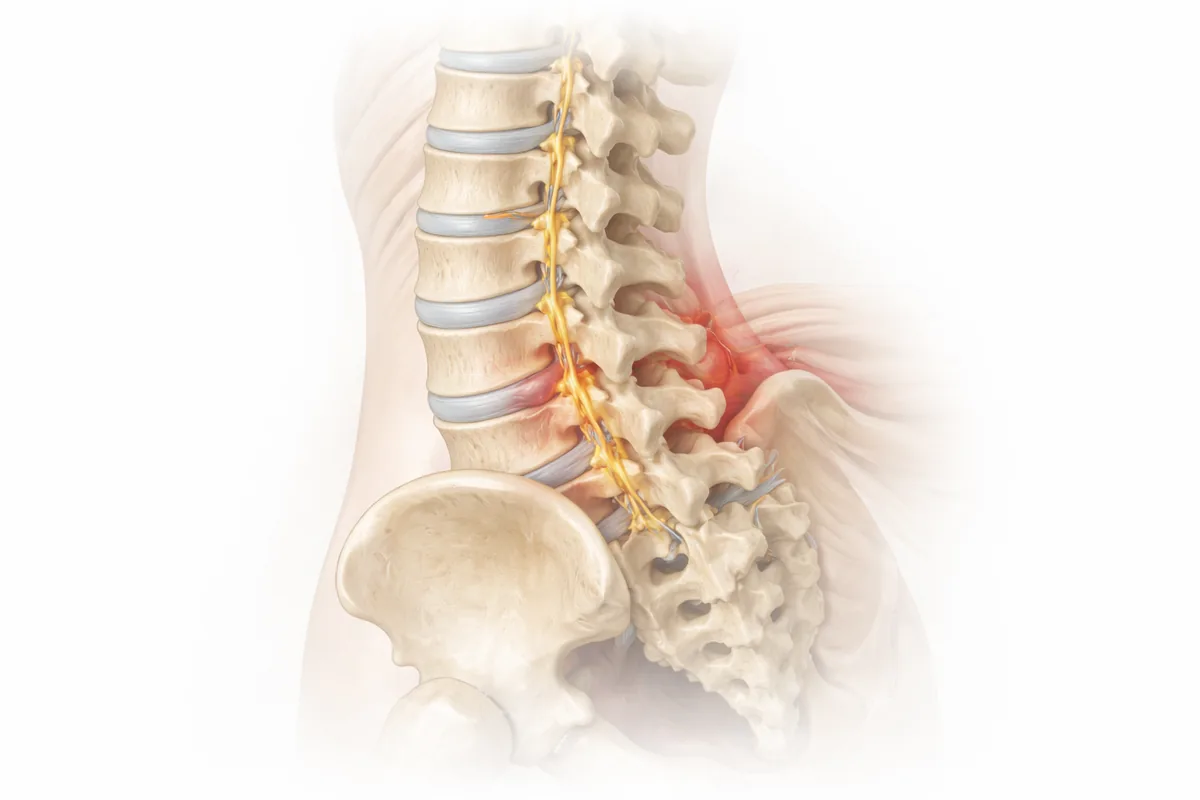
Lower back pain is the most common form of back pain and one of the leading reasons patients seek orthopedic care. Whether your pain stems from muscle strain, degenerative disc disease, or nerve compression, Dr. Steven Cyr provides both nonsurgical and surgical evaluation to determine the best path forward for your situation.
What Causes Lower Back Pain?
The lumbar spine—the lowest region of your back—bears significant load with every movement, bend, and lift. This area is vulnerable to several conditions:
Muscle and Ligament Strain is often the first culprit. Sudden movements, poor lifting mechanics, or overuse can cause acute muscle tears or ligament sprains that create localized pain and muscle guarding.
Herniated Lumbar Discs occur when the gel-like center of a disc ruptures through the outer ring, potentially irritating or pressing on nearby nerve roots. This can cause sharp, radiating pain down the leg—a condition often called sciatica.
Lumbar Stenosis develops when the spinal canal narrows, compressing the nerves inside. This typically causes pain that worsens with standing and walking but improves with sitting or bending forward.
Spondylolisthesis happens when one vertebra slips forward over another, disrupting the normal alignment and often pinching nerves or straining soft tissues.
Degenerative Disc Disease is a gradual loss of disc height and integrity over time, reducing cushioning between vertebrae and leading to chronic pain, stiffness, and sometimes nerve compression.
Facet Joint Arthritis involves wear and tear of the small joints on the back of the spine, causing localized pain that may radiate to the buttocks or thighs.
How Dr. Cyr Evaluates Lower Back Pain
A thorough evaluation is essential to identify the true source of your pain and determine whether surgery is necessary. Dr. Cyr's assessment includes:
- Detailed History: Understanding your pain pattern, what makes it better or worse, and how it affects your daily activities
- Physical Examination: Range of motion testing, strength and reflex evaluation, and special maneuvers to assess nerve involvement
- Imaging: X-rays to evaluate spine alignment, and MRI or CT scans to visualize discs, nerves, and bone structures in detail
- Neurological Assessment: Checking for signs of nerve compression that may indicate surgical need
This comprehensive approach ensures that treatment recommendations match your specific diagnosis rather than generalizing all lower back pain as the same condition.
Nonsurgical Treatment Options
Most acute lower back pain improves with conservative care. Dr. Cyr recommends starting with:
Physical Therapy and Core Strengthening: A structured program targets the deep abdominal and back muscles that stabilize the spine. Stronger core muscles reduce strain on discs and joints and prevent recurrent injury.
Anti-Inflammatory Medications: NSAIDs like ibuprofen or naproxen reduce inflammation and pain, particularly helpful in the acute phase.
Activity Modification: Avoiding positions that aggravate pain while maintaining gentle movement prevents stiffness and deconditioning.
Epidural Steroid Injections: When nerve inflammation is present, these injections deliver anti-inflammatory medication directly to the irritated nerve root, providing relief and allowing participation in physical therapy.
Postural Awareness: Proper lifting mechanics, ergonomic workspace setup, and conscious attention to posture during daily activities prevent recurrent strain.
When Surgery Becomes Necessary
Surgery is considered when conservative treatment fails to provide relief over several weeks to months, or when neurological symptoms (weakness, numbness, bowel/bladder changes) indicate nerve compression requiring urgent decompression.
Lumbar Fusion is Dr. Cyr's preferred approach for patients with instability or degenerative disc disease. By fusing two vertebrae together with bone graft material, fusion eliminates painful motion at that segment while restoring proper alignment. This approach provides long-term stability and is particularly valuable for patients with spondylolisthesis or severe disc degeneration.
Laminectomy with Fusion combines nerve decompression (removing the thickened ligament and bone that narrows the canal) with stabilization. This dual approach addresses both compression symptoms and underlying instability, preventing progressive slippage or collapse.
Life After Treatment
Recovery depends on whether you pursue conservative or surgical management. Most patients with muscle strain return to normal activities within 4-6 weeks. Those undergoing surgery typically begin physical therapy 2-3 weeks post-op and gradually return to full activity over 8-12 weeks. Dr. Cyr emphasizes that continued core strengthening and proper body mechanics remain important long-term to prevent recurrence.
Next Steps
If lower back pain is limiting your activities or affecting your quality of life, schedule a consultation with Dr. Cyr in San Antonio or Houston. During your visit, we'll determine the underlying cause and discuss whether nonsurgical management, injections, or surgical intervention is right for you.
Related Conditions:
Surgical Options:
Common Symptoms
- Localized pain in the lower back (lumbar region)
- Radiating pain down one or both legs
- Morning stiffness and difficulty bending forward
- Pain with prolonged standing or walking
- Muscle spasms and tightness
- Weakness or numbness in the legs or feet
Treatment Options
- Physical therapy and core strengthening exercises
- Anti-inflammatory medications and pain management
- Epidural steroid injections
- Activity modification and lifestyle changes
- Lumbar fusion surgery (surgical stabilization)
- Laminectomy with fusion (decompression and stabilization)
Frequently Asked Questions
What's the most common cause of lower back pain?
Muscle and ligament strain from poor lifting mechanics, overuse, or sudden injury is most common. Many cases resolve with rest and conservative care. Proper technique and core strengthening prevent recurrence.
How do I know if my lower back pain needs surgery?
Surgery is considered when conservative care (physical therapy, injections, activity modification) fails after 6-12 weeks, or when imaging shows a specific structural problem like severe stenosis, spondylolisthesis, or instability.
Can core exercises actually help lower back pain?
Yes, significantly. Strong core muscles support your lumbar spine and reduce strain on discs and joints. Physical therapy focusing on deep abdominal and back extensor strengthening is fundamental to both recovery and prevention.
Is there a treatment for lower back pain in San Antonio?
Yes. Dr. Cyr's San Antonio office (11459 Huebner Rd.) offers comprehensive evaluation, imaging, conservative care coordination, and surgical options when needed for lumbar pain conditions.
What should I avoid after lower back surgery?
Post-operative restrictions typically include avoiding heavy lifting (more than 10 lbs), bending forward, and twisting for 6-12 weeks depending on the procedure. Physical therapy gradually progresses you back to normal activities.