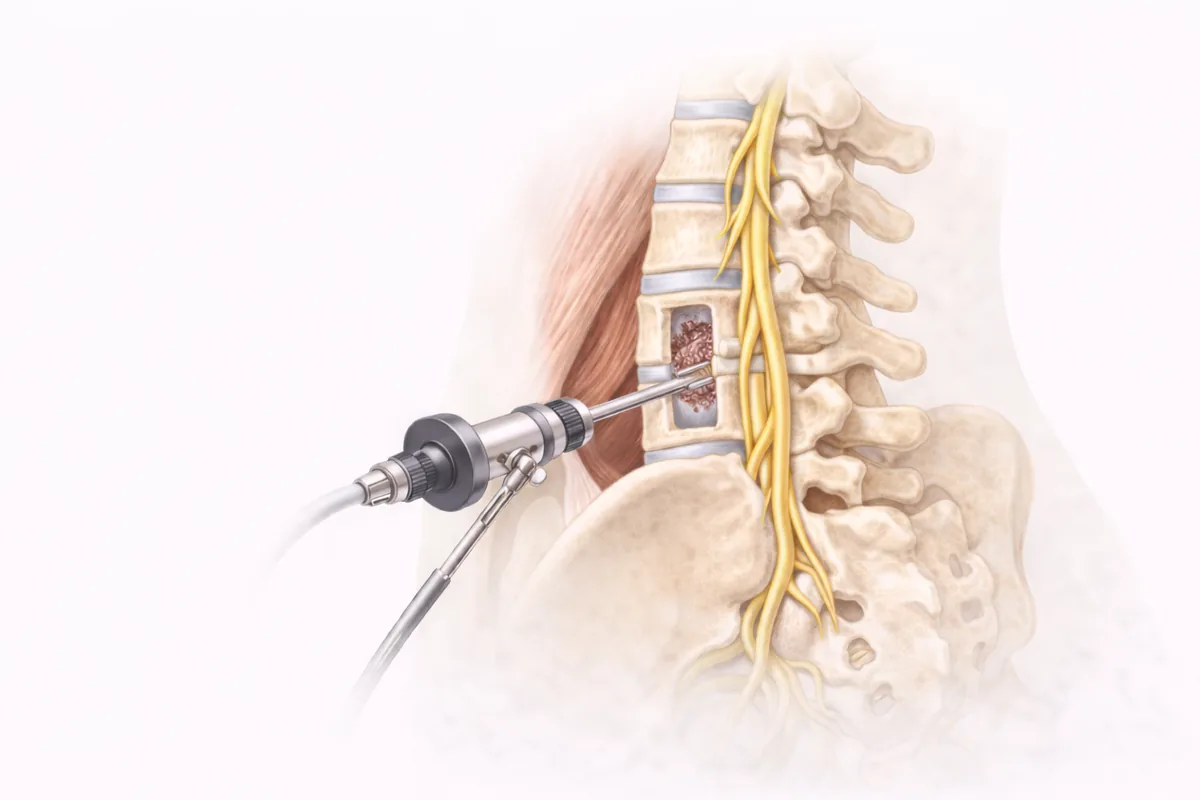
About Endoscopic Spine Surgery
Endoscopic spine surgery represents the frontier of minimally invasive surgical techniques. Using a small camera and specialized instruments inserted through incisions as small as 8mm, Dr. Cyr can perform precise decompressions with minimal disruption to surrounding tissue.
Dr. Cyr was a pioneer in this field — he became the first surgeon to perform endoscopic spinal surgery in a military setting, bringing innovative techniques to the Armed Forces during his tenure as Chief of Air Force Spine Surgery.
Advantages of Endoscopic Surgery
Compared to traditional open surgery, endoscopic techniques offer smaller incisions and less scarring, reduced blood loss, less post-operative pain, faster recovery and return to activity, and lower risk of infection. These advantages make endoscopic surgery an excellent option for patients with conditions that can be effectively treated with targeted decompression.
Candidacy
Not all conditions are suited for endoscopic treatment. Dr. Cyr carefully evaluates each patient's imaging and clinical presentation to determine whether an endoscopic approach will achieve the best outcome. When appropriate, the benefits are significant — many patients go home the same day and return to normal activities within weeks. For cases requiring both decompression and fusion for spinal stability, a laminectomy with fusion approach may be more appropriate.
Related Reading
- Spinal Stenosis Treatment
- Herniated Disc Treatment
- Newest Treatment for Spinal Stenosis
- Lumbar Spine Surgery
When This Procedure Is Recommended
- Disc herniations causing radiculopathy
- Foraminal stenosis
- Bone spurs compressing nerves
- Conditions suitable for targeted decompression
Surgical Techniques
- Endoscopic Discectomy
- Endoscopic Foraminotomy
- Endoscopic-Assisted Decompression
- Ultra-Minimally Invasive Approaches
Frequently Asked Questions
What is endoscopic spine surgery and how does it differ from traditional surgery?
Endoscopic spine surgery uses a small camera and specialized instruments through tiny 8mm incisions to precisely decompress nerves. Traditional open surgery requires larger incisions cutting through muscle tissue, resulting in more tissue damage and slower recovery.
Who is a good candidate for endoscopic spine surgery?
Endoscopic surgery works best for targeted decompression of disc herniations, bone spurs, or stenosis in specific locations. Not all spine conditions are suited for this approach—Dr. Cyr evaluates each patient's imaging and anatomy to determine candidacy.
How fast is recovery from endoscopic spine surgery?
Recovery is significantly faster than open surgery. Many patients go home the same day and return to normal activities within 2–4 weeks. This is one of the biggest advantages of the endoscopic approach.
Is endoscopic surgery as effective as traditional spine surgery?
Yes, when properly indicated. Endoscopic techniques achieve excellent pain relief and decompression results for appropriate cases. The key is careful patient selection by an experienced surgeon.
What happens if endoscopic surgery doesn't solve my problem?
If endoscopic decompression doesn't provide adequate relief or if your spine requires fusion for stability, additional surgery can be performed. However, the minimally invasive approach often resolves symptoms in well-selected patients.