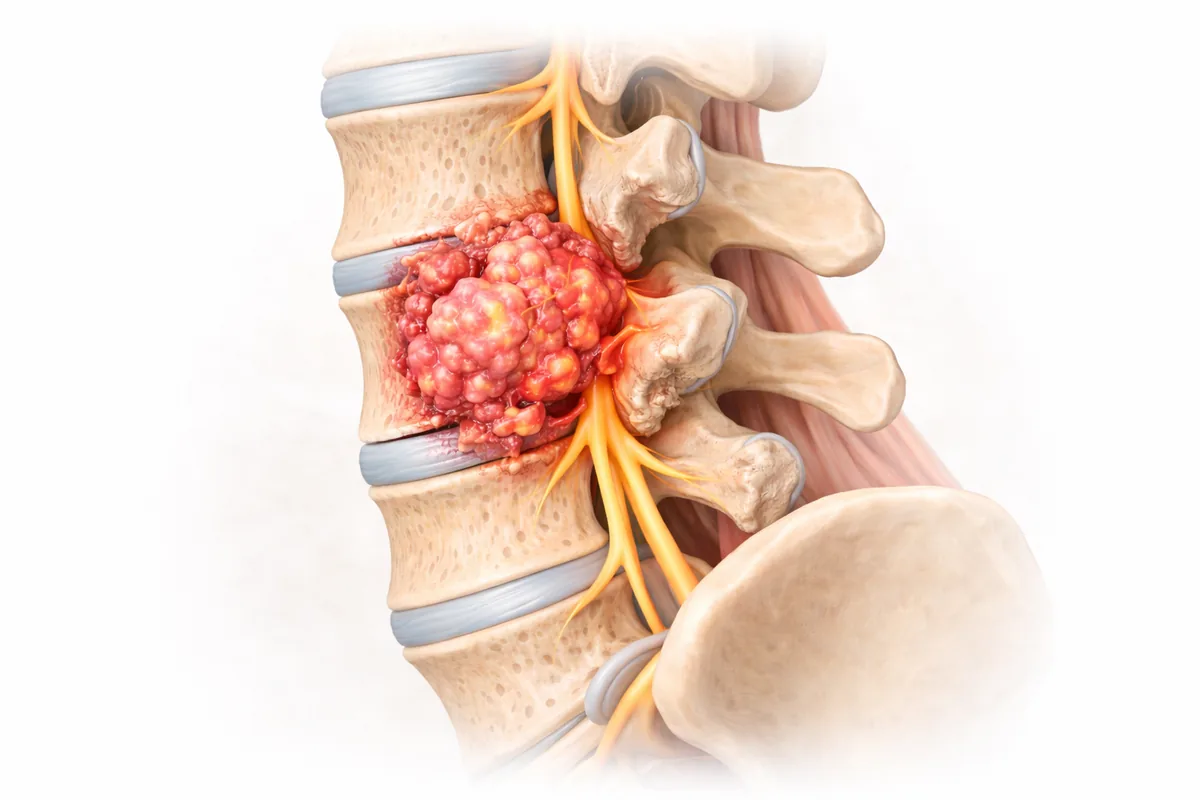
Understanding Spinal Tumors
A spinal tumor is an abnormal growth that develops in or near the spine. While the word "tumor" can sound alarming, it's important to understand that not all spinal tumors are cancerous. However, any tumor affecting the spine requires prompt diagnosis and specialized care—especially when it threatens your neurological function or spine stability.
Spinal tumors are broadly categorized into two main types:
Primary Tumors originate directly in the spine or spinal cord. These can be either benign (non-cancerous) or malignant (cancerous). Common primary tumors include meningiomas, schwannomas (nerve sheath tumors), and ependymomas.
Metastatic Tumors are the most common type. These develop when cancer from another part of the body—such as the lungs, breast, prostate, or kidneys—spreads to the spine. This is a serious condition that requires urgent evaluation and coordinated care.
Tumors can also be classified by location: extradural (outside the spinal cord), intradural-extramedullary (within the membrane surrounding the cord but outside the cord itself), or intramedullary (within the spinal cord itself). The location determines how the tumor affects your nerves and spine stability.
Symptoms That Shouldn't Be Ignored
Many patients with spinal tumors experience progressive symptoms that develop over weeks or months. If you notice any of the following, seek medical evaluation immediately:
- Progressive back or neck pain that worsens at night or when lying down
- Weakness or numbness in your arms, legs, feet, or groin
- Loss of sensation or changes in how you feel touch or temperature
- Difficulty walking, loss of balance, or clumsiness
- Loss of bladder or bowel control (a sign requiring urgent evaluation)
- Stiffness in the neck or back that doesn't improve with rest
These symptoms occur because growing tumors compress the spinal cord or nerve roots, disrupting the signals between your brain and body. Early recognition and treatment can help prevent permanent nerve damage.
Diagnosis: Precision Imaging & Evaluation
Accurate diagnosis is the foundation of effective treatment. My approach combines cutting-edge imaging with careful clinical evaluation:
MRI (Magnetic Resonance Imaging) is the gold standard for evaluating spinal tumors. It provides detailed images of the spinal cord, tumor location, and any pressure on surrounding nerves.
CT (Computed Tomography) scans show bone detail and help guide treatment planning, particularly for surgical approaches and spinal stabilization.
Biopsy may be needed to determine if a tumor is benign or malignant, and to identify the specific tumor type. This information is crucial for selecting the right treatment strategy.
Blood tests and advanced imaging protocols help assess your overall health and whether cancer has spread to other parts of the body.
At our San Antonio and Houston offices, I coordinate with oncologists, radiologists, and pathologists to ensure every patient receives a complete, accurate diagnosis before treatment begins.
Treatment: Multidisciplinary & Compassionate
Spinal tumor treatment is never one-size-fits-all. It depends on the tumor type, location, size, whether it's benign or malignant, and how much it's affecting your spinal cord or nerve roots. My treatment approach is always multidisciplinary—meaning I work closely with your oncology team, radiation specialists, and other experts to create a comprehensive plan.
Surgery is often the cornerstone of treatment. Surgical goals include:
- Tumor resection: Carefully removing as much tumor as possible while protecting your spinal cord and nerve roots
- Decompression: Relieving pressure on the spinal cord to restore neurological function
- Spinal stabilization: When tumor removal compromises spinal stability, fusion or instrumentation may be necessary to prevent future problems
My surgical philosophy emphasizes maximizing tumor removal while minimizing neurological risk. Intraoperative monitoring and advanced imaging techniques help me work with precision.
When a laminectomy and fusion is needed, this procedure removes part of the vertebra (lamina) to access and remove the tumor, then stabilizes the spine with fusion or instrumentation.
Radiation Therapy is often used after surgery to target any remaining tumor cells and reduce recurrence risk. It's particularly valuable for metastatic disease, where multiple spine levels may be involved.
Chemotherapy may be recommended depending on tumor type and whether cancer has spread elsewhere in the body.
Why Choose a Specialized Spine Surgeon?
Managing spinal tumors requires deep expertise in spine anatomy, tumor biology, and surgical technique. My training combined neurosurgical and orthopedic spine surgery during a fellowship at Mayo Clinic—one of the nation's premier spine centers. This dual training gives me the neurological insight of a neurosurgeon and the orthopedic structural expertise needed to handle complex, unstable cases.
Whether your tumor is primary or metastatic, benign or malignant, I'm equipped to offer you the most current surgical options and coordinated multidisciplinary care.
What to Expect
When you come in with spinal tumor concerns, expect:
- Thorough evaluation of your imaging and medical history
- Detailed discussion of your diagnosis, treatment options, and realistic expectations
- Honest conversation about the risks and benefits of surgery versus other treatments
- Coordination with your oncology and other specialist teams
- Clear surgical planning if surgery is recommended, with explanations of the approach and recovery timeline
Compassionate Care for a Serious Diagnosis
A spinal tumor diagnosis can feel overwhelming. My goal is to provide you with clear information, expert surgical care when needed, and the confidence that you're in capable hands. Many patients with spinal tumors go on to maintain good quality of life with appropriate treatment.
If you've been diagnosed with a spinal tumor—or if you're experiencing symptoms that concern you—I encourage you to schedule a consultation. We serve patients throughout San Antonio, Houston, and surrounding areas.
Related Conditions & Treatments
Dr. Steven Cyr | Board-Certified Orthopedic Spine Surgeon
Common Symptoms
- Progressive back or neck pain (often worse at night)
- Weakness or numbness in arms or legs
- Loss of bladder or bowel control
- Difficulty walking or loss of balance
- Loss of sensation in the legs, feet, or groin
Treatment Options
- Advanced imaging (MRI, CT, biopsy)
- Multidisciplinary oncology coordination
- Surgical tumor resection and decompression
- Spinal stabilization and fusion
- Radiation therapy
- Chemotherapy
Frequently Asked Questions
Are all spinal tumors cancerous?
No. Many spinal tumors are benign, including meningiomas and nerve sheath tumors. However, any tumor affecting the spine requires prompt diagnosis and specialized care. Metastatic tumors (cancer from elsewhere) are more common than primary spine cancers.
What symptoms should raise concern about a spinal tumor?
Progressive back or neck pain worsening at night, weakness or numbness in limbs, loss of bladder or bowel control, or unexplained neurological changes warrant urgent evaluation. These symptoms may indicate nerve compression from a tumor.
How is a spinal tumor diagnosed?
MRI is the gold standard, showing tumor location, size, and relationship to nerves and spinal cord. CT scans provide bone detail. Biopsy may be needed to determine if a tumor is benign or malignant. Blood tests assess overall health.
What is the goal of spinal tumor surgery?
Surgical goals include removing as much tumor as possible while protecting the spinal cord and nerves, relieving nerve compression, and stabilizing the spine if needed. Surgery is often combined with radiation or chemotherapy.
Can I get spinal tumor treatment in San Antonio?
Yes. Dr. Cyr, trained in both orthopedic and neurosurgical spine techniques, evaluates and surgically treats spinal tumors at his San Antonio office (11459 Huebner Rd.) with multidisciplinary oncology coordination.