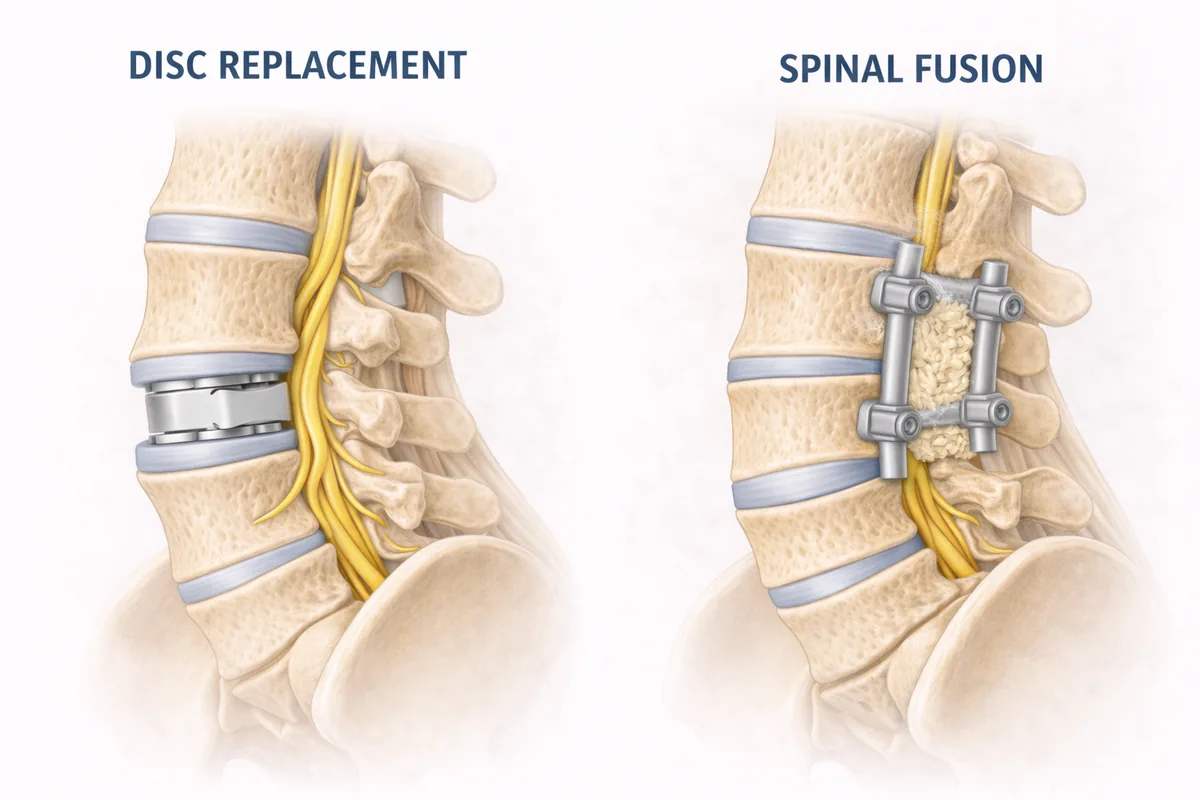
Two Proven Approaches
When a damaged spinal disc requires surgical treatment, two primary options exist: spinal fusion and total disc replacement. Both are well-established procedures with strong track records, but they work in fundamentally different ways.
Spinal Fusion
Fusion involves removing the damaged disc and joining the two adjacent vertebrae together using bone graft and hardware (screws, rods, or cages). Over time, the vertebrae grow together into a single, solid segment.
Fusion has been the gold standard for decades and remains an excellent choice for many patients, particularly those with spinal instability, significant deformity, or multi-level disease.
The trade-off is that fusion eliminates motion at the treated level, which can increase mechanical stress on adjacent discs over time — a phenomenon known as adjacent segment disease.
Total Disc Replacement
Disc replacement involves removing the damaged disc and inserting an artificial disc that mimics the natural movement of the spine. This preserves motion at the treated level.
The advantage is that by maintaining motion, disc replacement may reduce the long-term risk of adjacent segment disease. The disadvantage is that not all patients are candidates — factors like facet joint arthritis, spinal instability, and osteoporosis may preclude disc replacement.
How Does Dr. Cyr Decide?
The choice between fusion and disc replacement depends on the specific diagnosis and location of the problem, the condition of the facet joints, the number of levels involved, the patient's age, activity level, and bone quality, and whether instability or deformity is present.
Dr. Cyr's training at the Mayo Clinic — which combined both orthopedic and neurosurgical perspectives — gives him a unique vantage point for making this determination, whether the problem involves the lumbar spine or cervical spine. He was among the first surgeons to perform total disc replacement in a military setting and has extensive experience with both approaches.
What the Research Shows
Long-term clinical studies have demonstrated that disc replacement provides comparable or superior pain relief to fusion at single levels, with the added benefit of preserved motion. However, fusion remains the preferred approach for certain conditions, and neither option is universally "better" — the right choice depends entirely on the individual patient.
Related Reading
- Disc Replacement vs. Fusion — A Surgeon's Perspective
- Lumbar Fusion Surgery
- Laminectomy with Fusion
- Herniated Disc Treatment
- Spinal Stenosis Treatment
Next Steps
If you're considering spine surgery and want to understand which approach is best for your situation, a consultation with Dr. Cyr can provide clarity. He will review your imaging, examine you, and explain the rationale behind his recommendation. Dr. Cyr maintains practices in both San Antonio and Houston, offering this expert-level surgical consultation and care at both locations for patient convenience.
Frequently Asked Questions
What is adjacent segment disease and why does fusion increase the risk?
Adjacent segment disease occurs when discs or joints above or below a fused segment develop arthritis or degeneration. Fusion eliminates motion at that level, potentially increasing mechanical stress on neighboring discs over time, though fusion remains a highly successful long-term approach.
Who is a good candidate for disc replacement?
Ideal candidates are younger patients with single-level disc disease, healthy facet joints, no spinal instability, good bone quality, and no significant arthritis. Older patients with multiple-level disease, osteoporosis, or facet arthropathy typically do better with fusion.
How do the recovery times compare between fusion and disc replacement?
Both procedures have similar immediate recovery periods of 4-6 weeks. However, disc replacement patients sometimes return to activity slightly sooner since the spine maintains some motion. Long-term recovery depends more on individual rehabilitation commitment than the surgical approach.
Does preserving motion with disc replacement prevent future surgery?
Disc replacement may reduce (but not eliminate) the risk of adjacent segment disease compared to fusion. However, long-term data shows that both approaches have good durability. The 'best' choice depends on your specific diagnosis, age, and anatomy.
Can I get disc replacement or fusion surgery in San Antonio and Houston?
Dr. Cyr performs both approaches at his San Antonio and Houston practices. He personally evaluates each patient and recommends the approach—whether fusion or disc replacement—that best matches their anatomy and long-term goals based on his extensive Mayo Clinic training.