A herniated disc can feel like your back has turned against you. One wrong movement—or sometimes no particular movement at all—and suddenly you're dealing with pain that radiates down your leg, numbness in your foot, or weakness that interferes with grip strength. You find yourself searching for "herniated disc specialist" or "herniated disc doctor near me," hoping to find someone who can explain what's happening and map out a clear path to relief.
I understand that frustration. As a board-certified orthopedic spine surgeon with Mayo Clinic training—combining both neurosurgical and orthopedic spine fellowship—I've spent my career helping patients like you sort through the complexity of disc-related pain. My approach is straightforward: understand what's really going on, explore conservative treatment first, and only recommend surgery when it's the right call.
What Actually Happens With a Herniated Disc
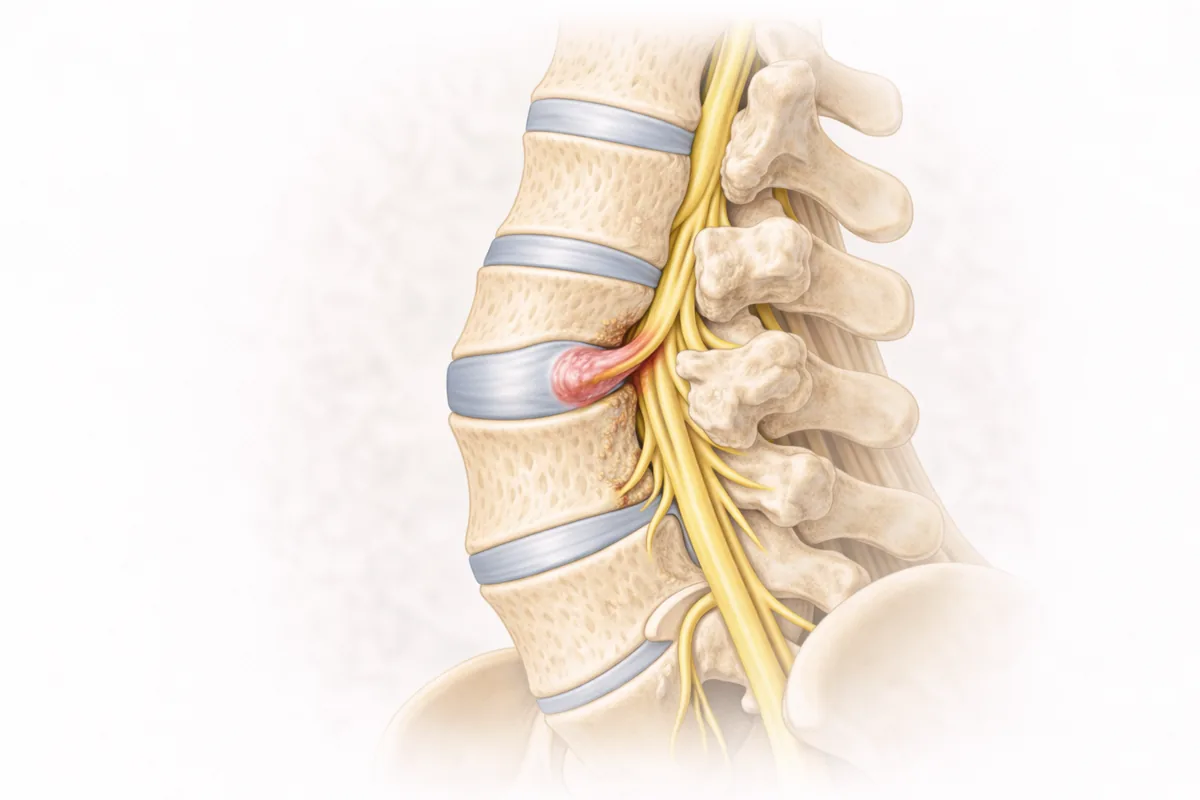
Your spine is built on a stack of bones (vertebrae) separated by discs that act as shock absorbers. Each disc has a tough outer layer and a softer nucleus in the center. When that nucleus pushes through the outer layer—whether from aging, cumulative wear and tear, a sudden injury, or even an awkward lift or twist—that's a herniated disc.
The pain you feel often isn't from the disc itself. It's from the herniated material pressing on a nearby nerve. Depending on where the herniation occurs and which nerve gets irritated, you might experience pain in your lower back, sharp pain radiating down your leg (like sciatica), numbness in your foot, or even weakness in your grip or leg muscles.
Not every herniated disc causes symptoms. Many go unnoticed. But when a herniation does compress a nerve, the symptoms can be serious enough to affect your work, sleep, and quality of life.
How I Diagnose Herniated Disc Problems
When you come to see me in San Antonio or Houston, diagnosis doesn't start with an MRI. It starts with your story.
I want to know about your symptoms in detail: Where exactly does it hurt? Does the pain change with certain movements—sitting, bending, coughing? When did it start, and has it gotten better or worse? I also ask about your medical history, any previous back injuries, and what your typical day looks like.
Then comes a thorough physical examination. I assess your posture and spinal alignment, test your reflexes, check muscle strength in your legs and feet, and evaluate sensation. These findings often tell me a lot about which nerve might be involved and how much pressure it's under.
Advanced imaging—MRI and sometimes CT scans—confirms what the clinical exam suggests. An MRI gives me detailed images of the disc, the spinal cord, and the nerves. This combination of history, physical examination, and imaging is what leads to an accurate diagnosis and appropriate treatment recommendations.
Conservative Treatment: Why It Works for Most People
Here's what many patients don't realize: most herniated discs improve with nonsurgical care.
My first-line approach focuses on reducing inflammation, protecting the nerve, and gradually restoring function. This typically includes:
- Physical therapy tailored to your specific herniation and symptoms, focusing on core strength and spine stability
- Activity modification so you're not constantly aggravating the irritated nerve
- Medications like NSAIDs or muscle relaxants to manage pain and inflammation
- Epidural steroid injections when appropriate, to reduce swelling around the compressed nerve and give you relief while physical therapy takes effect
I also discuss lifestyle factors—ergonomics at your desk, proper lifting technique, sleep position—because small changes often make a big difference.
The timeline matters here. It typically takes 6 to 12 weeks of consistent conservative care to see meaningful improvement. Many patients benefit from injections plus structured physical therapy, which allows them to regain function without surgery.
When Surgery Becomes the Right Choice
Surgery isn't my default. It's my option when conservative care hasn't worked or when the situation demands it.
I consider surgical intervention when:
- Conservative treatment has failed after a reasonable trial period (usually 8-12 weeks of consistent care)
- Pain is intolerable or progressive and significantly impacting your quality of life
- Nerve compression is severe and there's risk of permanent neurological damage (progressive weakness, loss of bladder/bowel control)
- Imaging confirms that the herniation is directly compressing the nerve that matches your symptoms
When surgery is appropriate, I typically recommend a lumbar fusion approach rather than simple disc removal. Fusion stabilizes the spine at the affected level, addresses the underlying instability, and has proven long-term results in my hands. I may also combine this with laminectomy-fusion if there's additional pressure from bone or ligament involvement.
The Difference Between Diagnosis and Treatment
One thing I emphasize to my San Antonio and Houston patients: finding a herniated disc on imaging doesn't automatically mean you need surgery. Many people have disc herniations that never cause problems. The key is matching the imaging finding to your actual symptoms and then tailoring treatment to your specific situation.
This is where surgeon expertise matters. It's not just about knowing how to perform surgery—it's about knowing when to recommend it and when conservative care is the smarter path.
What You Can Do Right Now
If you're experiencing back pain, leg pain, numbness, or weakness, don't wait for it to resolve on its own. The sooner you get an accurate diagnosis, the sooner you can start appropriate treatment and prevent the problem from worsening.
Look for a spine specialist—not just any doctor, but someone with specific training and experience in spine conditions. Ask about their approach to conservative care and surgery. Find someone who explains the reasoning behind their recommendations and answers your questions thoroughly.
My goal with every patient is the same: get you to accurate diagnosis, guide you through the most appropriate treatment (which is often conservative), and reserve surgery for situations where it truly makes a difference. I work this way in both my San Antonio and Houston practices because herniated discs don't recognize city lines, and excellent spine care shouldn't either.
Related Reading:
- Herniated Disc: Symptoms & Treatment
- Bulging Disc vs. Herniated Disc
- Sciatica & Sciatic Nerve Pain
- Diskectomy Surgery
- Microdiscectomy vs. Fusion
If you'd like to discuss your specific situation, I'm here to help. Schedule a consultation with me to get a clear picture of what's going on and a treatment plan tailored to your needs.
Frequently Asked Questions
What percentage of herniated discs are found on imaging but never cause symptoms?
Studies show that 20-40% of people with herniated discs visible on MRI never experience symptoms. This is why matching imaging findings to your actual clinical symptoms is essential—a herniated disc doesn't automatically require surgery.
How long does it take a herniated disc to improve with conservative care?
Most herniated discs improve within 6-12 weeks of consistent conservative treatment including physical therapy, activity modification, and sometimes epidural injections. Some cases take longer, but progression is generally steady.
Can a herniated disc herniate again after I recover?
Yes, recurrent herniation is possible at the same level or at adjacent levels, especially if core stability and postural habits aren't maintained. This is why long-term physical therapy and lifestyle modifications are important.
Why does Dr. Cyr prefer fusion over disc replacement for herniated discs?
Fusion provides superior long-term stability and is particularly effective for patients with instability or multiple-level disease. While disc replacement preserves motion, fusion has more predictable outcomes in Dr. Cyr's surgical experience.
Can I find a herniated disc specialist in San Antonio or Houston?
Yes. Dr. Cyr is a board-certified spine surgeon with Mayo Clinic training who specializes in herniated disc evaluation and treatment. He maintains offices in both San Antonio and Houston for patient convenience.